Is Amazonism the answer to declining incomes?
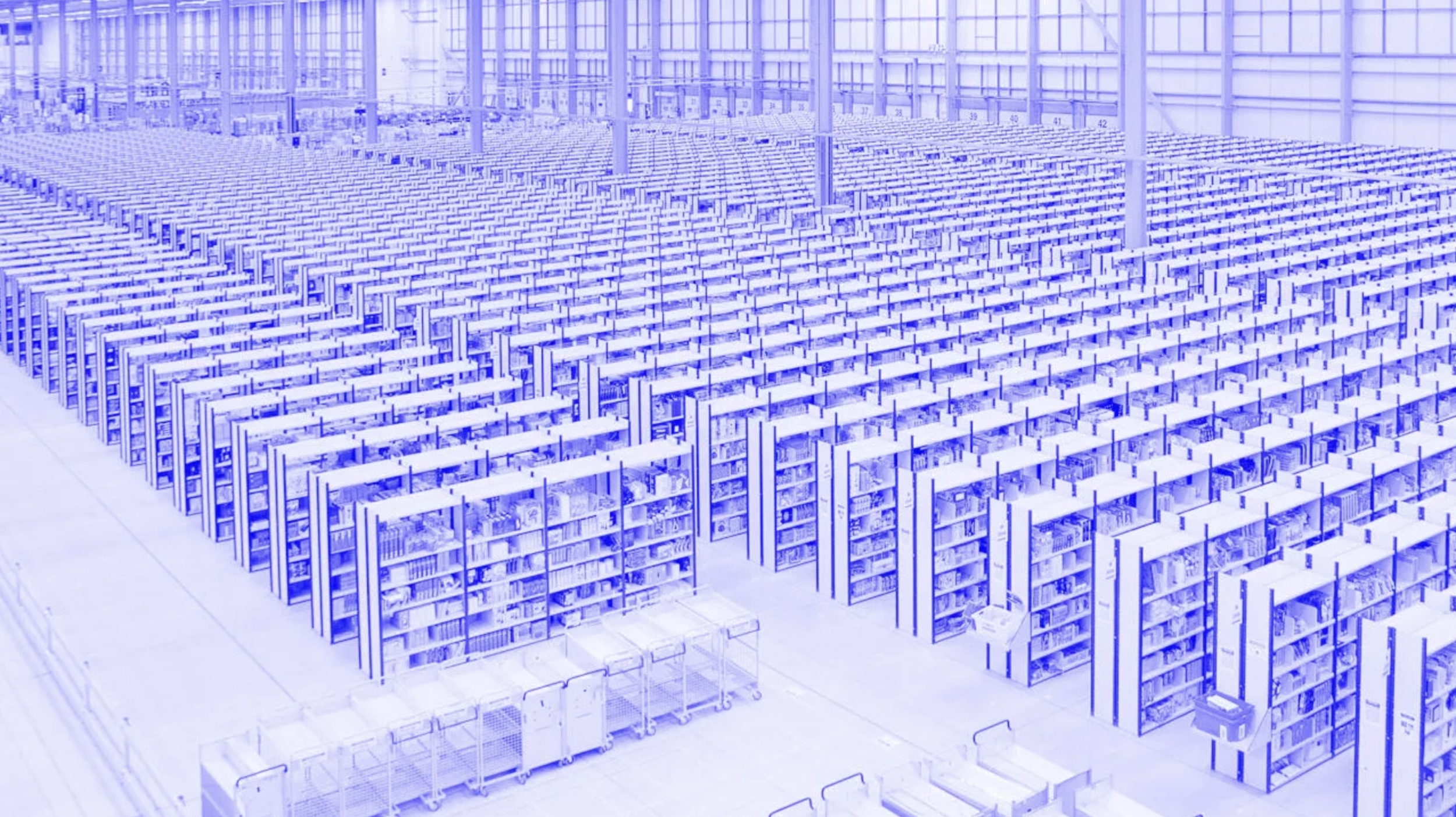
A terrible beauty is born - the Amazon fulfilment centre.
Amazon is hardly a successor of Fordism, but it is its logical conclusion. As US households' strategies to cope with a 30-year decline in living standards run out, what’s next?
It’s now undeniable that since the 1970s, most households' real incomes have fallen in the USA.
Tracing the sources of the US’s high levels of inequality, Robert Reich, economist and former economic advisor to President Clinton, identified three coping strategies American households adopted over the past 40 years to maintain their living standards.
The first involved women entering the workforce from the 1970s onwards. Of course, this wasn’t a bad thing — it was a welcome outcome of the feminist movement and greater women’s access to higher education. However, the data show this mechanism served to prop up stagnant or declining male incomes more than generating economic independence for women.
Once the first coping strategy ran out of steam, the second coping mechanism involved people working longer hours. Now that both men and women were breadwinners, the main way to compensate for falling wages was to work more — often up to over 50 hours a week. Over time, however, the benefits of this mechanism were gradually eroded.
The third coping strategy involved people exhausting their savings and getting into debt to compensate for their reduced spending power, which accelerated from the early 2000’s. During ‘The Great Prosperity’ in the 1950s-1960s, households could save 9% of their income per year, but as wages atrophied into the 2000’s, maintaining living standards meant dipping into savings, relying on credit cards and investing in property. Private household debt exploded so that by 2007, the average US home owed 138% of it after tax income.
In response, consumer behaviours have adapted and changed, and brands have led as much as followed this social evolution.
Nothing has reversed this trend in the US, especially since Donald Trump was elected President in 2017, promising to bring back jobs and wages for his base.
It’s a harsh lesson of economic history, but since the industrial revolution started putting people out of work through automation in the nineteenth century, most of the jobs that went never came back. A recent McKinsey analysis says it's highly unlikely the jobs that went offshore will ever be re-shored.
Reich’s story is one of one of families doing all they can to maintain their living standards while the jobs disappear, new ones emerge, and incomes continually lose spending power.
On the rise, however, is inequality. From the IMF global stability report to Thomas Piketty’s Capital in the Twenty-First Century, the economic evidence suggests economic and wealth inequality is destined to get much worse. Some have even declared a new gilded age as the number of billionaires bloom, producing the highest income and wealth disparity since the 1920s.
Amazon: the next coping strategy?
The obvious question to ask now is: what will be people's next coping strategy?
While these three coping strategies are not quite dead, neither are they quite alive, and the world is looking for a solution beyond them. It’s hard to trust anyone who reassures that 'this time, it's different'.
It’s possible the fourth coping mechanism will be Amazon.
As Amazon grows to become 'earth's marketplace', it is the exemplar of hyperscale, tech-driven discount retailers. In one sense, Amazon brings nothing new to the household dilemma - for decades, Walmart and Costco have 'given value back to consumers' through aggressively competitive pricing based on a very lean, efficient business model.
Amazon is taking this to the next level.
Scott Galloway puts what's happening in stark terms: Amazon and consumers are ‘conspiring’ to kill brands. Amazon's model is built on eliminating the cost of branding and returning that to the consumer in lower prices and more money in their pockets.
This conspiracy is backed up by a titanic distribution system, use of big data, predictive logistics, and cash pile to acquire and develop new technologies at pace and scale far greater than all competition.
Amazon’s mission is to monopolise the future
Amazon’s purchase of Whole Foods for $13.7 billion provided Amazon with a supply chain and distribution infrastructure to enable them to forward integrate with their online shopping and logistics and delivery platforms. Combined, this enabled Amazon to radically drop Whole Foods’ prices by up to 43% to smother competition which cannot afford to compete.
At the same time, Amazon is taking on everyday consumer goods like batteries and nappies with their own-brand versions, shredding individual product categories in a similar way to discounters Lidl and Aldi. Every time Amazon announces entering a new market category from household goods to entertainment, their stock prices soar and their rivals’ plummet. This is not normal economics, but Amazon is no normal competition.
Add to that their superior investment in voice technology to short-circuit visual brand cues, forcing consumers to become more reliant on Alexa’s cheaper own-brand alternatives, and the future feels already written.
What could earth's marketplace have in store?
Things are never so simple, but this evolution is huge for increasingly cash-strapped households. Amazon literally delivers them the chance to maintain or even improve living standards by shopping with them.
It’s an intoxicating promise. But what does this mean in the long-term?
Please indulge me for a moment. Philosopher Immanuel Kant's categorical imperative held that to know if an act is ethical, you should be able to apply it universally without contradiction (shout out to Chidi in The Good Place). If I want to kill someone, I must ask myself, ‘what if everyone killed everyone?’ This doesn’t work rationally, therefore killing is wrong.
A similar thought experiment: what if Amazon killed all competition?
Would earth’s marketplace improve people’s fortunes and those of future generations?
I don’t have the answer, but I have a few questions.
After dominating each market category, would Amazon move to jack up prices now that their customers were made captive, or keep them low?
After lowering prices dramatically, would this eventually lead to further downward pressure on average wages?
Will advanced automation technologies accelerate ‘the gig economy’ and unemployment through aggressive automation?
Could Amazon become too big to fail given consumers’ and markets’ dependence on them?
Alternatively, could their technologies actually prevent the worst impacts of these?
Why and when would this coping strategy run out of road?
Who knows what Kant would say?
In the meantime, come what may, Amazon is going to continue profoundly affecting markets, marketing, shopping and how individuals and households cope.
I suspect Scott Galloway is right when he says Amazon, and the rest of the ‘big four’ – Apple, Google and Facebook – should be broken up in the interest of fair competition.
But as we emerge from period of unprecedented global financial crisis, we should remind ourselves of the familiar mantra ‘too big to fail’ and ask what would it mean if Amazon ever became ‘too big to fail’?
Keeping this phrase in mind would, at least, keep us focused on ensuring the positive attributes of Amazon-like businesses can bring and protecting against the pitfalls that may also ride with them.