Brand populism in the age of anger
“Things fall apart; the centre cannot hold”
- The Second Coming, W. B. Yeats.
In his latest take on HBO’s intent to take on Netflix at their own game, Scott Galloway made an interesting point about how mass consumer markets in the US are ‘bifurcating’
Brands that are winning today, he says, are those standing at opposite poles from each other — Gucci vs. Amazon, Mercedes vs. Toyota, iOS vs. Android, Emirates Airlines vs. Jet Blue. Luxury vs. Mass market. These brands are prospering while many of those caught in the middle of the market serving ‘everyone’ are getting pummelled.
Some of the reasons for this trend are linked to technological disruption, competition and media clutter, which make it harder to brands to cut through to increasingly distracted audiences. Reasons which advertising and media agencies claim expertise in.
But how might this shift also relate to a deeper cultural zeitgeist? Is this ‘bifurcation’ of brands a market reflection of what’s happening more broadly across society and politics? And, if so, what does this mean for brand strategy?
Brand populism
Chantal Mouffe, a political theorist writing about the ‘populist moment’ in western Europe and the US, explains it like this:
For the past thirty years, we’ve had a centre-left/centre-right consensus that made everything seem nice, but in reality papered over the fissures encoded in neoliberalism. The 2008 financial crisis brought all this to a head, and the inability of this central consensus to solve ordinary people’s real problems has driven them towards the edges. All this has been amplified by rising income and wealth inequality, precariousness, made obsolete by new technologies, and a kind of ‘anti-politics’ that has reduced democracy to the technical management of societies’ wants and desires rather than genuine engagement with people’s lived experience and what they really need.
Consequently, amongst those seeking answers to the problems they experience, the centre is no longer seen as capable of providing solutions. Lurking in the shadows, the populist right has taken first mover advantage, channelling people’s anxieties and grievances in very counter-productive ways. Mouffe argues that these grievances and our political impasse must be resolved through an inclusive, counterbalancing populist movement focused on restoring real democracy.
This populist moment we find ourselves in has implications for brand strategy. Mark Ritson recently pointed out that brand survival today may depend more on being firmly ‘about’ something or standing ‘against’ something than standing for everyone.
This echoes Mouffe’s formulation of healthy politics as ‘agonistic pluralism’ - defining who ‘we’ are (the brand and those who identify with it), defining who ‘they’ are (the competition, non-users’ identities) and how to force change (market competition and consumer behaviour). In this formulation, brand competition is a different form of political competition, and not too different from populist politics in that, while less may be at stake, success depends on opposition.
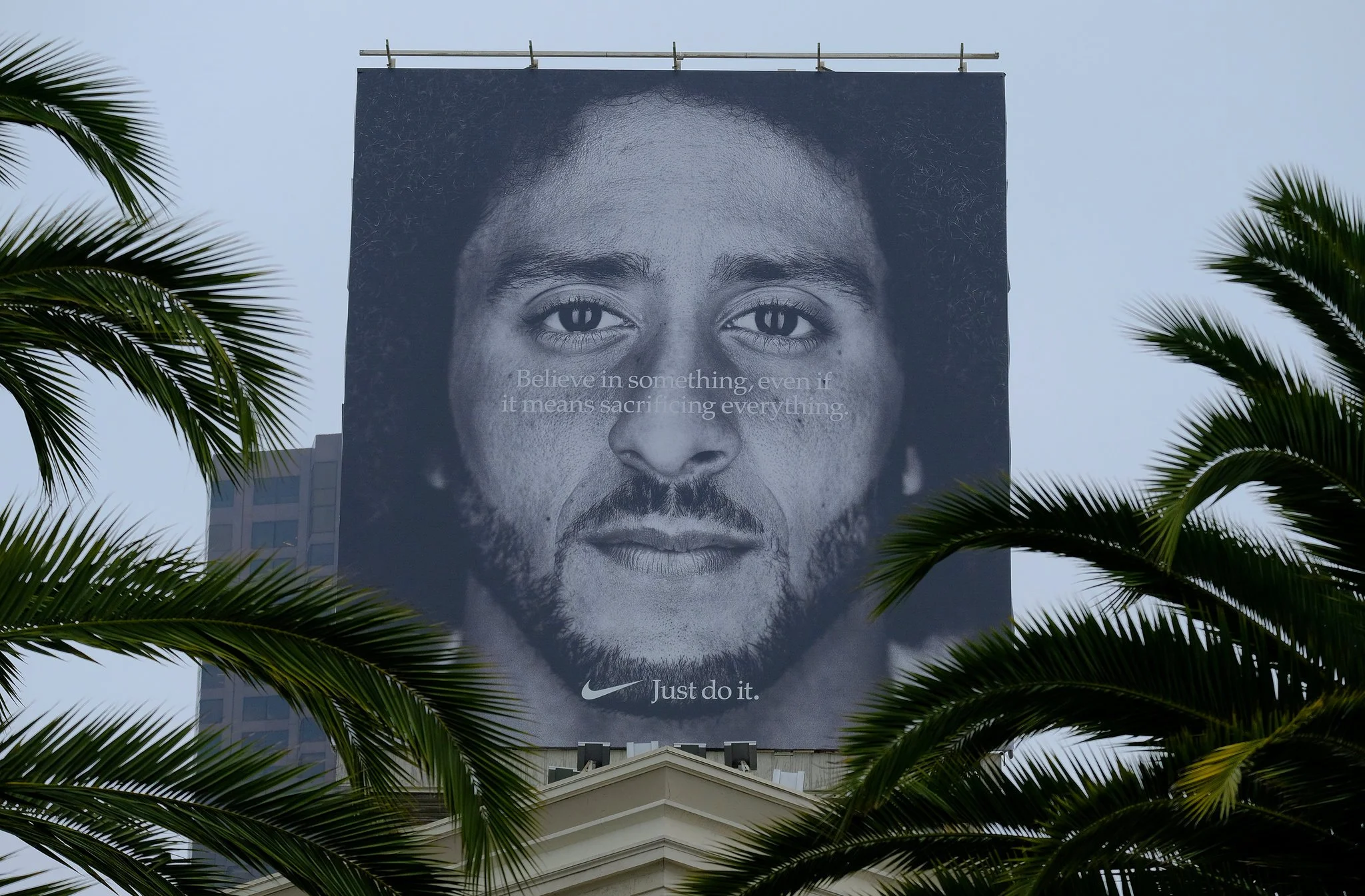
The obvious brand to mention in this moment is Nike.
Through their use of Colin Kaepernick to revive Nike’s 30-year-old ‘Just Do It’ brand positioning, the new Nike campaign has re-framed its relationship with American Dream — set big goals, work hard and you can achieve anything, no matter the obstacle. But, with this ad, the very use of Kaepernick seems to have pitched Nike, judging from the reaction, against ‘white America’?
A choice has been made to politicise the brand. In response, some engaged in ritualistic sneaker burnings, and many more shared on social media. Yet, the TV ad portrays many different people experiencing different kinds of inequality making their wildest dreams a reality, a commercial representation intersectional identity politics - too woke for some, inspiring for others..
In the ad, Kaepernick inspires us to ‘Dream crazy’. But how many believe this is enough anymore? ‘Dream crazy’ can also be read in reverse: many Americans also believe changing their lives is just a ‘crazy dream’.
Strategic realism
Marketing wisdom today says brand growth is all about serving as many consumers as possible. Some refer to the ’20:60:20 rule’ —in any category, a brand has 20% lovers, 20% haters and 60% normals. But if 20% are with you, 20% are against you, and 60% could go either way, bearing in mind more people in the middle are fed up of being in the middle, So to grow sales and market share, you have to go after the many more normals, while not alienating your lovers.
But in an increasingly politicised and polarised society, can that 60% at the centre still hold? Consumers are bifurcating aligned to increasingly oppositional values, identities and communities. So, in a world where people are tired of the same ol’ thing, sick of the same ol’ schtick, what should you do?
In a more polarised economy, society, culture, what options do brands have if you can’t court the middle in the way that you used to? There’s no strong evidence that the ‘big tent’ brand is over in the age of American populism, but as culture wars and identity politics move further into the mainstream, brands are needing to respond in kind.
The objective of any brand is ultimately sales and profitability. Some brands, like Nike, have been choosing to back affluent segments to the liberal side of the idiosyncratic American political spectrum. Nike reasoned that sacrificing one section of their customer base to grab attention and strengthen brand affinity among their fans and a greater number of regular consumers
This is what makes Nike’s Colin Kaepernick episode to interesting. Is it an anomaly, or is it a canary in the coal mine? As Martin Kornberger argues, brands are two-way ‘screens’ through which values flow between brand and society, and in a historic moment when every single brand symbol has the potential to become political, everything can become political. On the business side, as profit-seeking entities, most brands, even Patagonia, needs to make money and maximising your growth opportunity is is critical.
We may need to get used to the idea that brands will need to strategically weigh up much more than target consumer demographics and mindsets, they’ll need to consider politics and social class and build brand and advertising strategies around this. Or, in the case of Tito’s Handmade vodka, you embrace the ‘Trickster’ archetype - a character who emerges in times of structural ‘liminality’ according to political anthropologist Arpad Szakolczai - which gives certain types of brands permission to behave more quixotically to appeal to different and even opposing social groups to gain influence.
So, what might the future of brand strategy in the age of anger look like?
In short: brand populism.